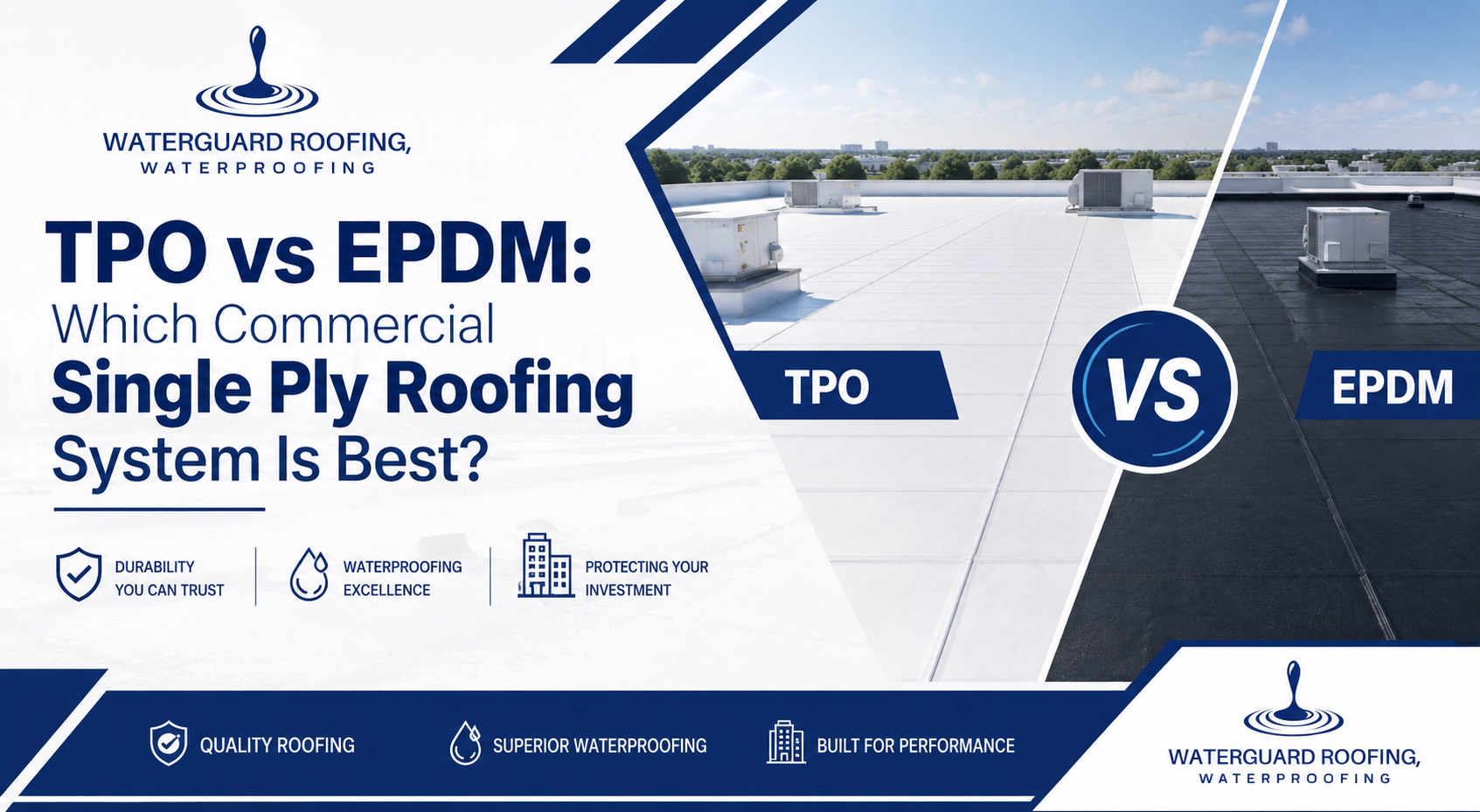
The selection of a commercial roof is an important decision with major implications for both your inventory protection and your long-term investment in the performance of your structure.
For low-slope or flat commercial roofs, the two main types of single-ply membrane systems available in the market today are TPO vs EPDM Roofing. Both provide excellent waterproofing; however, they represent two very different chemical formulations (i.e., polymers) and consequently, two very different types of “performance”.
How to Know Your Competitors: TPO vs EPDM Roofing
For purposes of comparison, it’s important to first determine the composition and properties of these products as they relate to commercial roofing systems.
TPO Membrane Roofing (Thermoplastic Polyolefin): The New Reflective Phenomenon
Commercially available since the early ‘90’s, TPO vs EPDM Roofing is a thermoplastic made up of two primary types of polymers (polypropylene and ethylene-propylene) blended into a single membrane material that can be re-heated until reshaped and cooled for final shape (melted). TPO membranes are manufactured primarily to be white/light grey/tan in appearance, or, reflectively, to reflect solar energy away from buildings.
EPDM Membrane Roofing (Ethylene Propylene Diene Monomer): The Tried-and-True Rubber Material
The marketplace has been using TPO vs EPDM Roofing as a synthetic rubber-based commercial roofing material for more than 50 years. EPDM is manufactured as a thermoset material such that the chemical bonds formed during the curing process do not change when heat is applied to EPDM; thus, EPDM cannot melt or otherwise be reshaped when subjected to heat. Traditional EPDM membranes are produced to be jet black; although water-resistant white finish versions are available, EPDM behaves like a very thick, durable piece of rubber at your facility.
Two systems can be compared based on their performance, multivariable data, and how those systems behave under the stress of physical punishment, how difficult or simple they are to install, and what your long-term financial return will be.
Cool Roof Dynamics: Energy Efficiency And Solar Reflective Index.
TPO vs EPDM Roofing is the clear leader in energy efficiency in all warm-weather areas. Its naturally reflective white surface can reflect as much as 80% of the solar rays back into the atmosphere, thereby keeping the building from absorbing heat and therefore allowing the building’s air conditioning system to operate normally without the thermal load of radiant heat. EPDM, with its carbon-black surface, absorbs solar heat, which is great if you live in a cold weather environment, but creates a significant thermal load.
Installation Techniques: Adhesive Tape vs Hot Air Welded Joints
The seams on any single-ply roofing system are most at risk, as they are where each of the two sheets overlaps.
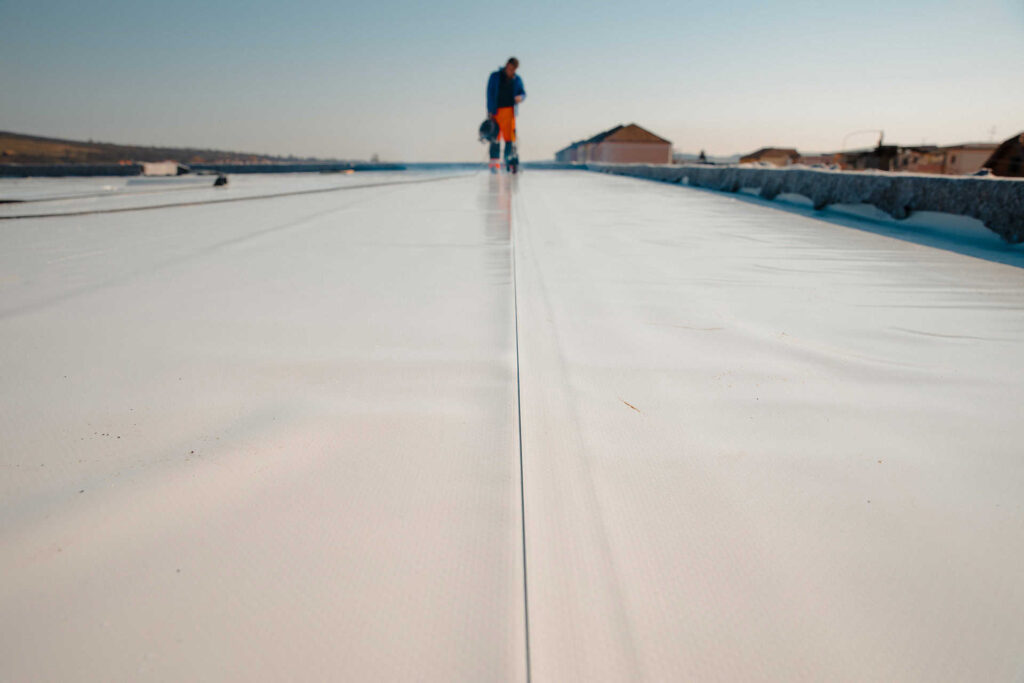
TPO vs EPDM Roofing seams are bonded by using specialized robotic hot air welding equipment that melts the two sheets together (welded) into a single, monolithic membrane that is physically stronger than either of the individual membranes alone.
EPDM’s seams cannot be melted or fused together; instead, they are bonded together using mechanical and chemical methods via liquid primers and heavy-duty seam tape. Both of these methods are very effective at forming a watertight seal; however, they rely on the adhesive properties of the seam tape to remain intact, which can fail faster than a fused joint over time.
The long-term durability of TPO vs EPDM Roofing, when subjected to heavy foot traffic, hail, thermal shock, and other forms of impact, exceeds that of TPO by an order of magnitude. Furthermore, due to the nature of EPDM being a rubber-based product, it possesses the ability to dynamically expand and contract with changing temperatures without splitting or rupturing. TPO’s natural rigidity provides outstanding tear and puncture resistance properties. However, early generations of TPO experienced severe weathering issues; today, the newest formulations from leading manufacturers equal or even exceed the long-term performance of EPDM for weathering.
The Most Important Reasons to Choose a Professional Roofer for Your Single-Ply Roof Installation
Installation of commercial single-ply roofing is a science and will not allow the flexibility of DIY installation or installation by an unlicensed contractor.
Precise Seam Integrity: When fusing TPO vs EPDM Roofing, it is essential to balance speed, temperature, and pressure with the use of some very complicated automatic walk welders. Professional roofing contractors constantly calibrate these machines to meet daily ambient humidity and temperature requirements to be able to provide the best possible weld.
Substrate and Core Assessment: A professional roofing contractor performs core cuts and moisture scans before installation and will verify the structural soundness and dryness of the existing roof deck, insulating layer, and vapor retarders.
Access to Manufacturer’s Warranties: Major roofing manufacturers will only issue long-term, no-dollar-limit (NDL) warranties on systems that have been installed by an authorized and certified roofing contractor who passes a detailed post-installation inspection.
TPO vs EPDM: Who is the winner?
There is no clear winner in the argument for TPO vs EPDM Roofing; the best option is contingent upon your plant goals. If your priority is to lower cooling expenses in the summer, create a highly efficient building, and have thermally fused permanent seam construction, then TPO would be best for your plant and also ensure roofing lifespan. If you are a facility owner located in a northern climate where maximum hail-resistant roofing and physical puncture resistance, want an established material with a low upfront cost, and have a long time until your roof will need to be repaired or re-roofed, then EPDM would be an excellent option as well, especially for flat roof systems.
FAQs
Which commercial single-ply option lasts longer, TPO vs EPDM Roofing?
A properly installed EPDM rubber roof can last 25 to 30 years due to its stable chemical cross-linking. Modern TPO systems typically last 15 to 25 years, depending on local UV exposure and installation quality.
Is TPO more expensive than EPDM?
TPO is generally slightly more expensive upfront than EPDM. This price difference is due to higher material costs and the specialized robotic hot-air welding labor required during installation.
Can you coat an old TPO vs EPDM Roofing to extend its lifespan?
Yes. Both systems can be coated with specialized silicone or acrylic fluid-applied membranes as long as the underlying insulation is completely dry and the structural seams are still intact.
Which roof system is more resistant to punctures and hail?
EPDM is highly flexible and behaves like thick rubber, giving it superior impact resistance against hail and tools. TPO is tougher and more rigid, which protects well against punctures but lacks EPDM’s elasticity.
Can TPO or EPDM be installed over an existing commercial roof?
Yes, this is called a roof recover. Most building codes allow a maximum of two roofing layers, meaning you can often lay down a new single-ply membrane over an old system if the structural deck is completely dry.